


English

 Manpreet Singh
Share: 


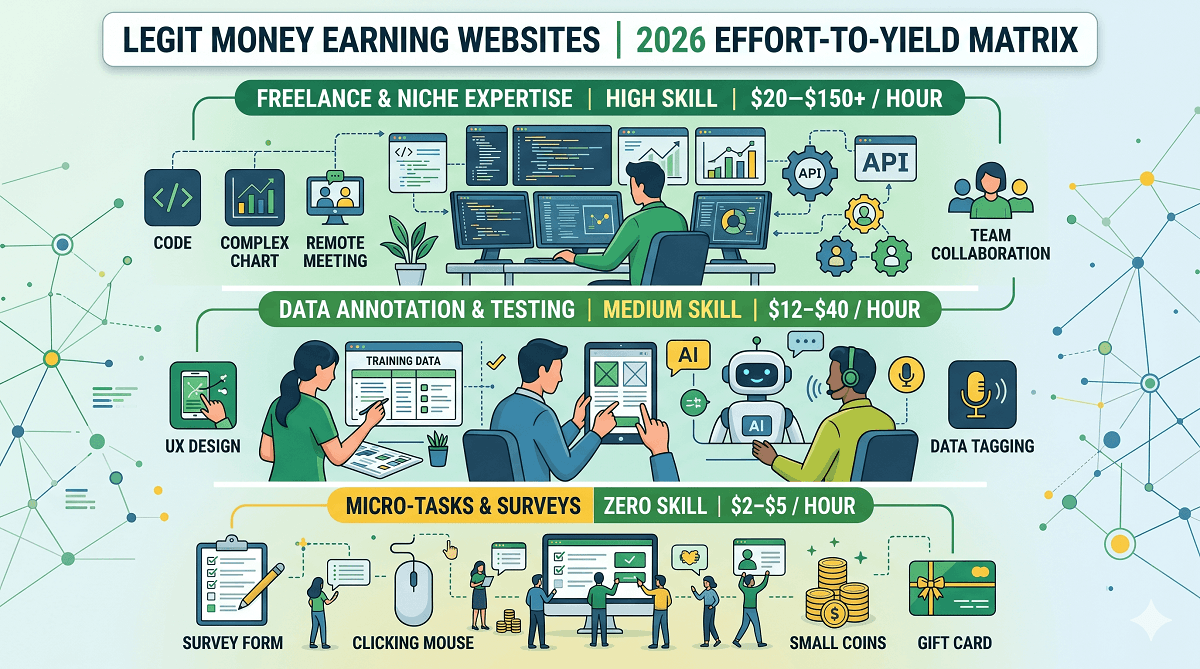
If you’ve searched for “money-earning websites,” you’ve already survived a tidal wave of algorithmic garbage. You’ve likely seen the YouTube thumbnails promising ₹50,000 a day for watching videos, or generic blogs telling you that taking surveys will somehow pay your mortgage.
Let’s kill that myth immediately.
The internet is flush with capital, but it is not a charity. The money you can make online is strictly dictated by the Skill Barrier and the Time Investment. To help you cut through the noise, we have categorized the most viable platforms into a realistic matrix. No fake guru promises—just the unvarnished mechanics of what these platforms require and what they actually pay out.
Before diving in, use this benchmark table to align your expectations with reality.
| Tier | Platform Category | Skill Barrier | ROTI (Return on Time Invested) | Best For… | Payout Logistics |
| Tier 1 | Arbitrage Marketplaces | High | ₹2000 – ₹15,000+ / hour | Tech, Design, & Niche Experts | Direct Deposit, PayPal, Crypto |
| Tier 2 | Human-in-the-Loop | Medium | ₹1200 – ₹4000 / hour | Detail-oriented testers | PayPal, Direct ACH |
| Tier 3 | Micro-Task Aggregators | Zero | ₹200 – ₹500 / hour | Monetizing idle downtime | Gift Cards, Points, PayPal |
These platforms offer the highest earning ceilings, but you must treat your profile like a standalone business. Clients do not pay you simply to exist; they pay you to solve specific, high-value technical problems.
It’s impossible to discuss online income without these two, but the game has fundamentally changed. Generative AI is rapidly cannibalizing generalist roles. You cannot compete by offering “basic data entry.”
Expert Pro-Tip: The highest-earning freelancers on these platforms design their gigs to allow for asynchronous work. If you value a lifestyle that affords un-rushed time during the day for offline priorities, focus strictly on milestone-based project work rather than hourly screen-monitoring contracts.
You don’t need to be a software engineer to make decent money here, but you do need strict attention to detail, native-level language proficiency, and patience.
Brands and researchers pay to watch you navigate their unreleased websites, apps, or decentralized protocols.
As AI models consume the internet, tech giants desperately need humans to train their algorithms.
Let’s be clear: these websites will not pay your rent. Companies design these sites strictly to monetize the 15 minutes you spend commuting or waiting in a lobby.
These are CPA (Cost Per Action) aggregators. Brands pay them to acquire users, and they kick a fraction of those pennies down to you.
A critical mistake beginners make is ignoring the payout logistics until it’s time to withdraw. Your earnings are only theoretical until they hit your account.
A: Yes. Whether you receive funds via PayPal, direct ACH deposit, or cryptocurrency, almost all jurisdictions classify this money as taxable income. Platforms like Upwork or Fiverr will require you to fill out a W-8BEN (for non-US citizens) or W-9 form before you can withdraw a single dollar. You are responsible for setting aside 15-25% of your earnings for tax season, depending on your local laws.
A: Absolutely. Legitimate money-earning platforms will never ask you for a deposit, an “activation fee,” or a “starter kit” purchase to begin working. Their business model relies on taking a percentage of the earnings you generate after the client pays you. If a website asks for your credit card to “unlock” tasks, it is definitively a scam.
A: Brands hire Tier 3 survey platforms to hunt down highly specific demographic profiles—for example, “IT managers who recently purchased enterprise firewall software.” If your initial screening answers do not exactly match the profile the client needs, the algorithm automatically kicks you out to ensure data integrity. This built-in failure rate is why the Return on Time Invested (ROTI) for survey sites is notoriously abysmal.
A: You do not need to mimic a traditional 9-to-5 schedule. The most sustainable approach, especially if you are transitioning to a full-time stay-at-home parent, is to strictly target milestone-based or asynchronous contracts. By avoiding hourly screen-monitoring software, you retain the flexibility to prioritize un-rushed quality time with your family. Approaching freelance work with the mindset of being a present co-traveler in your child’s life means prioritizing high-yield, low-supervision projects over low-yield hourly grinds.
A: Generalist skills (basic copywriting, logo design, data entry) have been entirely commoditized by AI. The market now pays premium rates exclusively to technical implementers and niche community builders. For example, knowing how to build and secure localized community sites (such as Telegram localization hubs or security tutorial platforms) is highly lucrative. Similarly, clients pay top dollar for developers who can move beyond basic templates and build custom WordPress themes from scratch using clean HTML and CSS, or properly configure complex permalink structures for technical SEO.
A: Yes, but only if you understand the underlying logistics. For global freelancers, crypto is often faster and cheaper than traditional wire transfers. However, you must carefully monitor network costs. If a platform pays out in USDT, opting for the TRC-20 network is generally the most efficient route. You will need a non-custodial wallet (like Trust Wallet or Phantom) or a primary exchange account (like OKX) to receive funds. Always calculate the TRX gas fees required to move those assets; poor timing during network congestion can eat directly into your profit margins.
A: It depends entirely on the tier. Tier 1 platforms (Upwork, Toptal) are globally accessible, though your location may influence the rates you can command. However, Tier 2 (Prolific, UserTesting) and Tier 3 (Swagbucks) heavily favor users in the US, UK, Canada, and Australia. If you register from outside these regions, your dashboard will likely remain empty due to a lack of localized client demand. Do not use a VPN to spoof your location; the system will permanently ban your account before your first payout.
A: The primary reasons are Terms of Service (ToS) violations and identity verification failures. High-tier platforms require government ID and often a live video call to verify your identity. Taking communication or payments off-platform to avoid the 10-20% platform fee will trigger algorithmic flags and result in an instant, unappealable permanent ban. Treat your platform profile as a critical business asset; risking it to save a few dollars in fees is mathematically disastrous.
Written by Manpreet Singh
An Internet wealth architect from India, a true master of turning clicks into gold. He possesses the innate ability to transform complex online models into actionable blueprints for everyday people, specializing in internet monetization, affiliate marketing, and mobile app revenue streams. Through his “low barrier to entry, high compounding returns” practical strategies, he has successfully guided thousands of global followers to convert their skills and passions into substantial online income.
How to Earn Money by Playing Games: The ₹10,000/Month Blueprint (Zero Risk)
Want to know how to earn money by playing games without risk? Skip the micro-task grind and learn the exact blueprint to earn daily UPI cash.
Manpreet Singh
Online Income Game 2026: Earn Real UPI Cash Daily (Zero Investment)
Looking for a genuine online income game? Avoid the entry fee trap, learn the secrets of referral income, and start earning instant UPI cash safely.
Manpreet Singh
Earn Money By Playing Games Without Investment: A Realistic Guide for India
Want to earn money by playing games without investment? Avoid scam apps, learn the referral secrets, and start earning instant UPI cash daily.
Manpreet SinghTable of contents:


Discover diverse earning methods on Taurus Cash APK, a mobile app offering tasks, skill-based games, and refer & earn programs. Join for a seamless income by completing daily tasks & earning commissions!




Businesse cooperation: [email protected]

 How to Earn