


English

 Manpreet Singh
Share: 


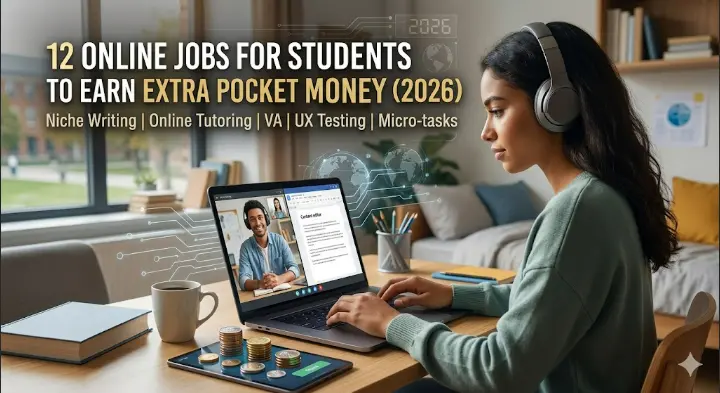
Most YouTube tutorials and TikTok threads about online jobs for students sell a fantasy. They pitch effortless, automated wealth while you sleep. As an editorial strategist who has tracked remote work trends, platform algorithms, and the gig economy for years, I can tell you that what happens behind the screen is far more grounded.
Earning extra pocket money online requires treating your limited free time with extreme operational discipline. If you are juggling midterms, lab sessions, and a social life, you do not need a volatile startup venture—you need flexible, realistic income streams that will not jeopardize your GPA.
To help you bypass the noise, this guide reverse-engineers the actual digital economy for students in 2026. We will examine operational data, exact platform entry points, onboarding requirements, and the hidden costs behind the most popular remote gigs.
Asynchronous jobs are the holy grail for students. You receive a brief and a deadline, but you decide whether to execute the work at 2:00 PM or 2:00 AM.
Generalist “content writers” who churn out generic 500-word blog posts have been largely displaced by AI. However, the market for subject matter experts remains highly lucrative. If you are a nursing student, a computer science major, or studying pre-law, B2B businesses will pay for your verified, human expertise to write technical guides, edit academic papers, or create study materials.
If you need a highly predictable way to earn realistic pocket money, online academic tutoring remains the most reliable sector. Parents are incredibly willing to pay university students to tutor high schoolers in STEM subjects, standardized exam prep, or languages.
These roles offer a more stable path to a realistic side income, but they demand rigorous time management because you must be online at scheduled hours.
Small business owners, solo agency founders, and digital creators often drown in administrative clutter. As a Virtual Assistant (VA), you might manage email inboxes, process invoices, schedule social media posts via Buffer, or create basic Canva graphics.
If you are mentally exhausted from studying and just want to earn a few dollars with minimal cognitive load, micro-tasking and user experience (UX) testing fit the bill.
Companies constantly need human eyes to tag images for AI training models, update inventory spreadsheets, or record themselves navigating a new app interface to find bugs.
For additional low-stress options to convert spare moments into extra cash, read our complete guide on Answering Surveys for Money.
Before you build a profile, factor in these operational costs that will eat into your realistic side income. Platforms do not operate for free, and ignoring these mechanics leads to rapid burnout.
To explore transparent income paths for students that guarantee zero upfront fees and instant payouts, check out our resource on Earning Without Investment.
The golden rule of digital gig work is simple: money should only flow u003cemu003etou003c/emu003e you. If an employer asks you to pay a u0022processing fee,u0022 buy specialized software, or purchase equipment with a u0022reimbursement checku0022 they send you, it is a fraud. Legitimate platforms deduct their fees automatically from your earnings; they never ask for your credit card to secure a job.
Yes, in almost all jurisdictions, freelance or gig economy income becomes taxable once it passes a certain threshold. Even as a student, you are legally considered a sole proprietor or independent contractor. You must track your earnings and set aside roughly 15-20% of your realistic income for potential tax liabilities. Always consult your local tax authority guidelines for the exact minimum earning threshold.
Operational data shows it takes 3 to 6 weeks of consistent daily pitching to land a first client. Your first few jobs will likely be low-paying because your primary objective is not immediate revenue, but acquiring 5-star reviews to build platform credibility. Once you possess social proof, securing subsequent jobs becomes exponentially easier.
This is a critical legal barrier. In many host countries (such as the US on an F-1 visa), international students are strictly prohibited from participating in off-campus work, including digital freelancing for overseas clients while residing in the host country. Violating this can lead to visa revocation. Always consult your university’s international student office before accepting any paid online work.
Asynchronous freelance writing, graphic design, and AI data training are ideal. These roles rarely require Zoom meetings or phone calls. Communication is handled almost entirely via asynchronous channels like email, Slack, or project management boards like Trello. You can execute the deliverables in complete solitude.
From a purely hourly perspective, no. While platforms like Swagbucks or SurveyJunkie are technically legitimate, the time-to-payout ratio is abysmal. You might spend 45 minutes answering demographic questions to generate ₹150 in points. Unless you are mindlessly clicking while watching Netflix, your time is better invested in building a tangible, marketable skill.
If you prefer a direct mobile task solution with fast UPI transfers to fund your daily student pocket money, you can download the official Taurus App Package to begin.
You do not need a registered corporate entity to begin. You can operate legally as a sole proprietor using your legal name. Most online platforms will pay you via direct bank transfer, PayPal, or Payoneer. You simply provide your personal banking details and your individual tax identification number during the onboarding KYC (Know Your Customer) process.
You do not need a ₹200,000 streaming studio setup, but relying on a 5-year-old laptop microphone will hurt your client retention. The minimum viable setup requires a stable fiber/broadband connection, a quiet room, and a dedicated USB headset (costing around ₹3000-₹5000). Crisp audio is far more critical than 4K video when explaining complex academic concepts to a paying student.
Written by Manpreet Singh
An Internet wealth architect from India, a true master of turning clicks into gold. He possesses the innate ability to transform complex online models into actionable blueprints for everyday people, specializing in internet monetization, affiliate marketing, and mobile app revenue streams. Through his “low barrier to entry, high compounding returns” practical strategies, he has successfully guided thousands of global followers to convert their skills and passions into substantial online income.
Taurus App Paid Surveys Guide: Zero Investment Daily UPI Cash
Among the multiple micro-task options available on the Taurus App, the Questionnaire section offers a direct, zero-investment path for Indian users looking to generate daily side income.
Manpreet Singh
Watch Video and Earn Money App India: Daily Yields, Rules & Fast UPI Transfers (2026)
For smartphone users searching for a reliable earn money app and video platform in India, task aggregators like Taurus have changed how micro-earnings work.
Manpreet Singh
Earn Real Cash on Teen Patti Master via Taurus App
If you are looking for a reliable way to win real money playing mobile games, Teen Patti Master is currently one of the most popular skill-based card games in India.
Manpreet SinghTable of contents:


Discover diverse earning methods on Taurus Cash APK, a mobile app offering tasks, skill-based games, and refer & earn programs. Join for a seamless income by completing daily tasks & earning commissions!




Businesse cooperation: [email protected]

 How to Earn