


English

 Abhinav Sharma
Share: 


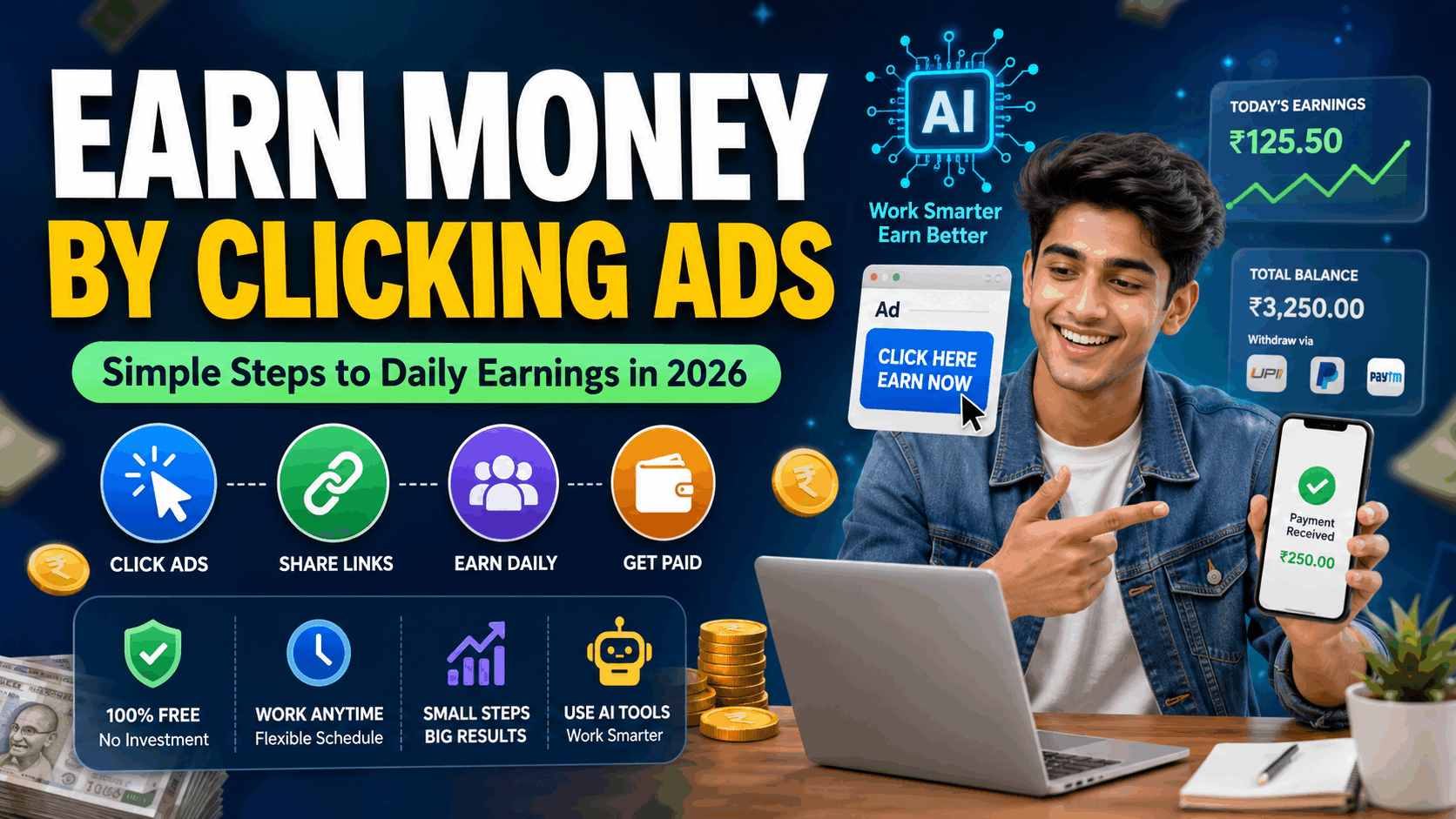
Have you ever thought about earning money by clicking ads? Many companies pay real people to watch their ads. You click an ad, view it for a few seconds, and earn a small amount. This is often called get paid to click.
Some platforms even let you get paid per click on your link. You share a link, and each click adds a few rupees. You can also build a simple daily habit to daily click earn money. There are also pay per click affiliate programs that pay you when someone clicks your affiliate link. Many pay per click sites make it easy to get started.
But where should you begin? How much can you really earn? In 2026, some new AI methods can help you earn smarter. How exactly? We’ll cover that later in this guide. First, let’s understand what pay-per-click ads are and why they work.
Pay-per-click (PPC) is an online ad model. Advertisers only pay when someone clicks their ad. No click, no cost. These ads can be text, images, or videos. They appear on search engines, social media, and websites. That’s the basic idea behind earn money by clicking ads.
As a viewer, you don’t get paid directly by advertisers. Instead, get paid to click (PTC) sites act as middlemen. They collect money from advertisers and share a small portion with you. Some platforms also offer pay per click affiliate programs. If you want to daily click earn money, using reliable pay per click sites is a simple start.
On most pay per click sites, you may encounter these ad formats:
Now let’s look at how you can earn money daily by clicking ads.
After learning the basics of pay-per-click ads, most people still care about a more real question: how do I actually start making money by clicking ads? What exactly should I do every day? Where do I begin?
Let me walk you through the answers step by step.
In the past, making money through pay-per-click ads was simple. You log into a platform, click ads, and wait for your earnings.
But in 2026, things are slowly changing. More and more people are starting to use AI tools to help. For example, AI can pick better tasks to do, analyze which links get more clicks, or even optimize the way you click ads.
In other words, the difference now is not just “whether you do it”, but “how to do it more efficiently”.
Next, I will explain clearly: how a normal user should start, what you mainly do every day, and whether AI tools can really help improve your overall earning efficiency.
When many people first come across get paid to click websites, they think these sites are like “earn while idling”.
But after doing it for a while, you will find that what decides your earnings is often not how many ads you click on a single day. It is whether you keep clicking every day.
This is because many pay per click sites do not always have ads. Some platforms refresh ads at fixed times. Others decide whether to give you more tasks based on your account activity.
That is why many long-term users have already built a fixed habit. Some open the site in the morning and finish the day’s ads quickly. Others check before bed to see if there are new tasks.
This sounds very ordinary, but most beginners cannot stay consistent.
And in 2026, some users have already started using AI to help with filtering. For example, which platforms have fewer ads recently, or which sites have many ads but very low per-click pay.
In the past, you could only learn these things by making mistakes. Now people already “analyze” first, then decide where to spend their time.
Clicking ads alone makes it hard to grow your earnings.
That is why many users later start looking into the get paid per click on your link model. The platform gives you a unique link. As long as someone clicks your link and enters the page, you get paid for that click.
But the interesting part is this: the link itself has little value. The key is “why would someone click it”.
A few years ago, many people shared links everywhere — on forums, in groups, in comment sections. Later, more and more people found that this method got fewer and fewer clicks. Sometimes platforms even flagged it as low-quality traffic.
Today, a more effective way is to hide the link inside useful content.
Some people write a tool recommendation. Others make a tutorial. Some just put the link in a video description. Users are already reading or watching the content, so clicks come more naturally.
This also explains why AI tools are becoming popular.
Because some people now use AI to test headlines, analyze click-through rates, and study what kind of content keeps users engaged. In the past, many things relied on “feeling”. Now it is more like doing small-scale data optimization.
Pay per click affiliate programs are different from regular ad clicking.
It is more like a “traffic amplification” model.
Some people write blog content. Others do software reviews. Many keep writing about “making money online” and then put their affiliate links inside.
The most obvious change after 2026 is that AI has made content creation very easy.
As a result, the internet suddenly has a large number of articles that “look like articles” but no one really wants to read. Many affiliate pages are packed with keywords, but clicks keep dropping.
Slowly, people started to realize a problem: AI can help you work faster, but it cannot directly solve the “realness” problem.
That is why many long-term affiliate users now intentionally keep some personal experience and observations. They even write things that are not so “standard”. Because what truly brings clicks is often not the most polished article, but something that feels like a real person wrote it.
If you really use pay per click sites for a long time, you will soon find that clicking ads alone has a clear income limit.
Each click pays very little.
That is why many users also do other tasks on the platform, like surveys, game trials, or video tasks.
Sometimes the real waste is not “earning too little”. It is that you already opened the platform but only clicked a few ads and then left.
Now some people even let AI help decide which tasks are worth doing. Some surveys pay well but take 30 minutes to finish. Some platforms pay out very slowly.
In the past, you could only learn by trying. Now many people filter first, then decide what to do.
Looking at all the methods above together, you will see that what really affects your earnings is often not a skill.
It is your rhythm.
Many beginners start with great enthusiasm. They sign up for many platforms at once and click many ads. But this state usually does not last long, because the whole process is messy.
The people who truly earn money by clicking ads over the long term do not spend a lot of time every day.
Instead, they repeat a small habit they are already used to. Maybe they just open a few fixed websites every day, check for new ads, update their links, and take a quick look at their data.
Over time, you will find that your earnings may not suddenly jump, but the whole thing becomes steady.
What AI really changes is not “making money for you”. It helps you reduce the low-efficiency, repetitive parts. It shows you where your time should go.
We have already explained how to earn money by clicking ads. By now, some of you may want to give it a try. Here are 3 pay per click sites you can try.
Taurus is an India-based app. You can earn money by clicking ads, watching videos, and doing small tasks. The minimum withdrawal amount is just 10 rupees. If you like to withdraw your earnings often, Taurus is a good choice to earn money by clicking ads.
TimeBucks is quite popular in India. You can earn from ads, videos, and surveys. According to most user feedback, the minimum payout is about 410 rupees. Many users say it is reliable. If you are interested, search for more information before deciding to use this app.
In GrabPoints, you can earn points by clicking ads, doing tasks, and installing apps. The minimum payout is about 250 rupees. Most users say it works well on mobile phones.
After learning about 3 related pay per click sites, now comes the key point that most people care about the most – how much money can I earn by clicking ads? Our short answer is: not a lot, but it can add up over time.
Each ad click usually pays a very small amount. Think about ₹0.1 to ₹2 per click. If you click 50 ads a day on a good pay per click site, you might earn ₹10 to ₹30 daily. Here is roughly how much you can earn from pure ad clicks on the 4 sites above.
Looking at these earnings, you can see the income is indeed small – only enough for simple expenses. In short, clicking ads won’t make you rich. But if you build a daily click earn money habit, use multiple platforms, and add referral links, you can still build a small side income.
Next, let’s look at how you can get paid after clicking ads and completing tasks.
After clicking ads, how do you get your money? Most sites offer a few common payment methods. Here are examples from the three platforms.
PayPal – Link your email to receive money.
UPI / Paytm – Fastest for Indian users, arrives in minutes.
Bank Transfer – Needs account number and IFSC code, takes 2–7 days.
Gift Cards – Amazon India gift cards are common.
Now, let’s look at things to know before using these sites.
1. Never pay to join
Any site that asks you to pay a registration fee or buy a membership is a scam. Real PTC sites are free to join.
2. Test withdrawals with a small amount first
After earning the minimum payout (e.g., ₹10 or 3 dollars), withdraw immediately. If the money doesn’t arrive, stop using that site.
3. Don’t expect to live on this income
Pure ad clicks earn at most a few tens of rupees per day. This is pocket money, not a job. Don’t waste too much time or dream of high earnings.
In short, earning money by clicking ads is real, but the income is very low – just pocket money. In 2026, you can use AI tools to filter tasks and links for better efficiency, but don’t expect auto-earning. Stay consistent and use multiple platforms to slowly build small earnings.
Some are scams, but real paying platforms exist. Stick to the sites recommended in this guide and test withdrawals first.
Pure ad clicks earn about ₹20–50 per day (using 3–4 platforms). Referrals and tasks may add a little more, but it’s still small.
No. Any site that asks for a registration fee is fake. Stay away.
Written by Abhinav Sharma
Abhinav Sharma is an internet passive income expert from India. He specializes in building automated profit systems, focusing on transforming digital products, smart affiliate marketing, and content assets into consistent “passive income.” His proven strategies have successfully guided thousands of students worldwide to break free from the cycle of trading time for money, achieving both financial and geographic freedom.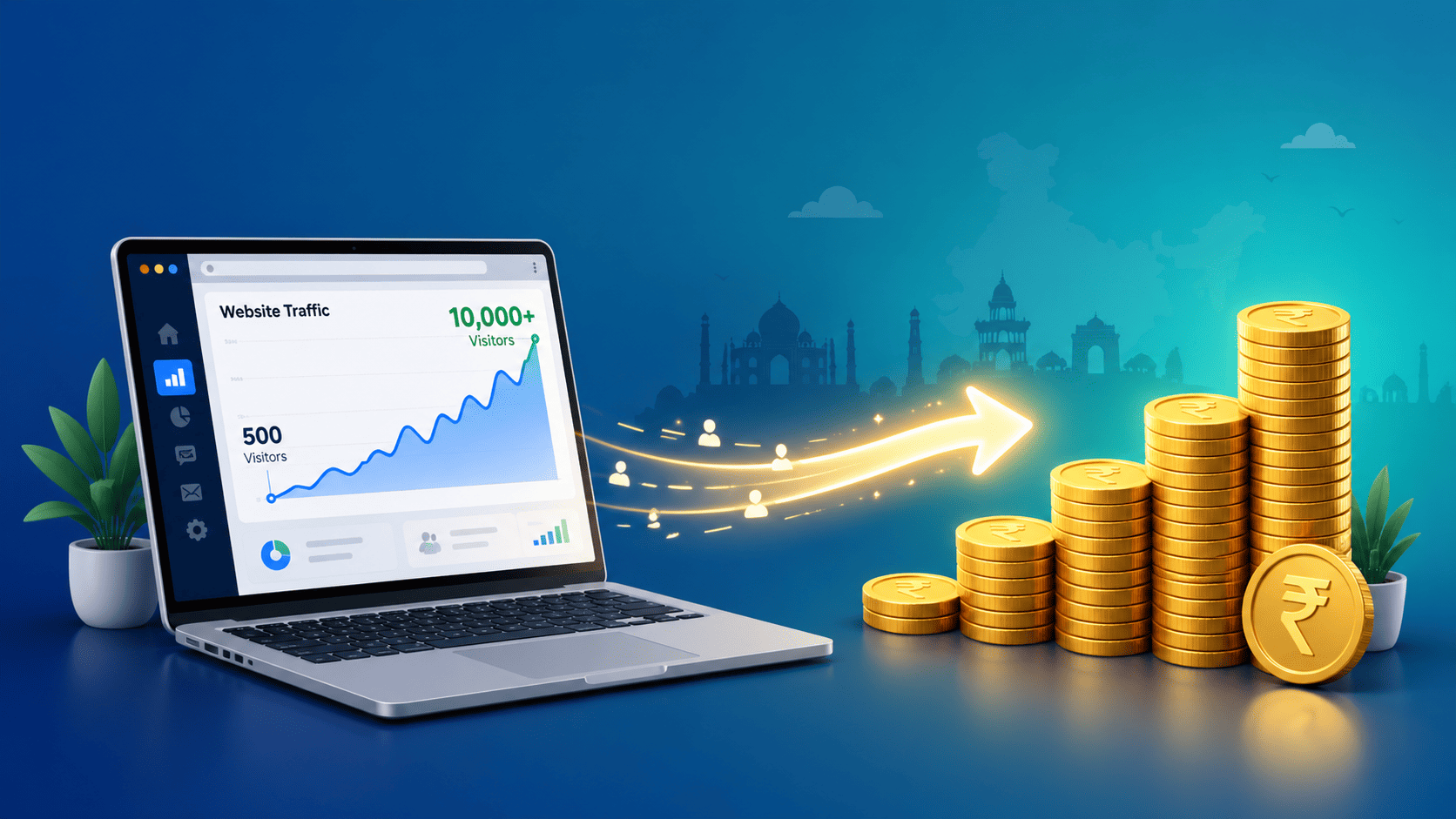
How to Make Money Blogging: The Final Step From Traffic to Income
Have blog traffic but making ₹0? Learn which monetization method works at 500, 1K, or 10K+ visitors. India income data.
Abhinav Sharma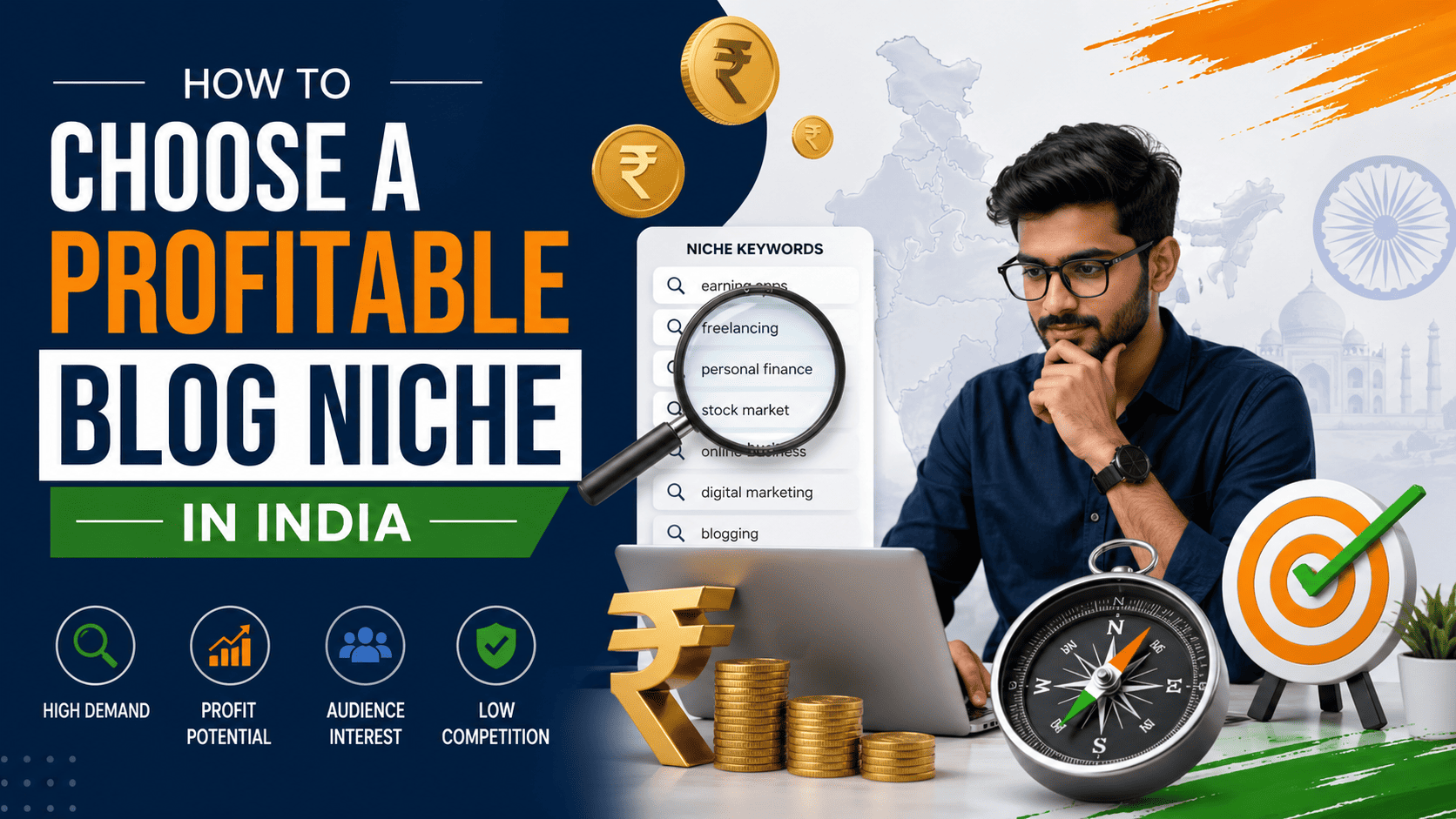
How to Choose a Profitable Blog Niche in India: A Step-by-Step Guide for Beginners
Want to choose a profitable blog niche in India without wasting 6 months? Validate demand, money, and competition step by step. Realistic 6–18 month timeline. India-specific niches that actually pay. Beginner-friendly, no theory.
Abhinav Sharma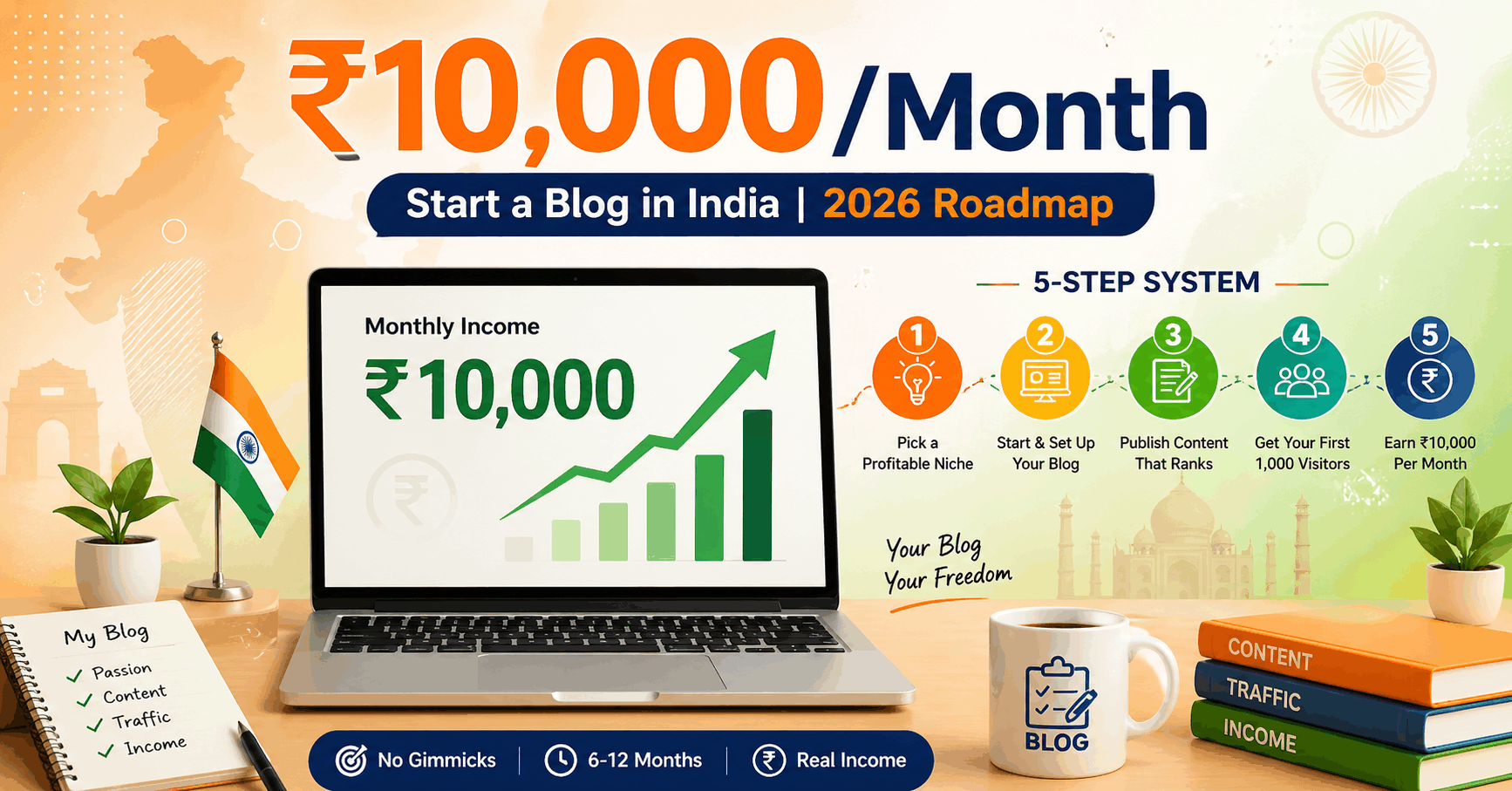
How to Start a Blog and Earn Your First ₹10,000 Per Month in India (2026 Roadmap)
Learn how to start a blog and earn money in India with this 5-step system. Realistic timeline to ₹10,000/month. Beginner-friendly, no shortcuts.
Abhinav SharmaTable of contents:


Discover diverse earning methods on Taurus Cash APK, a mobile app offering tasks, skill-based games, and refer & earn programs. Join for a seamless income by completing daily tasks & earning commissions!



Businesse cooperation: info@taurusofficial.in

 How to Earn