


English

 Abhinav Sharma
Share: 


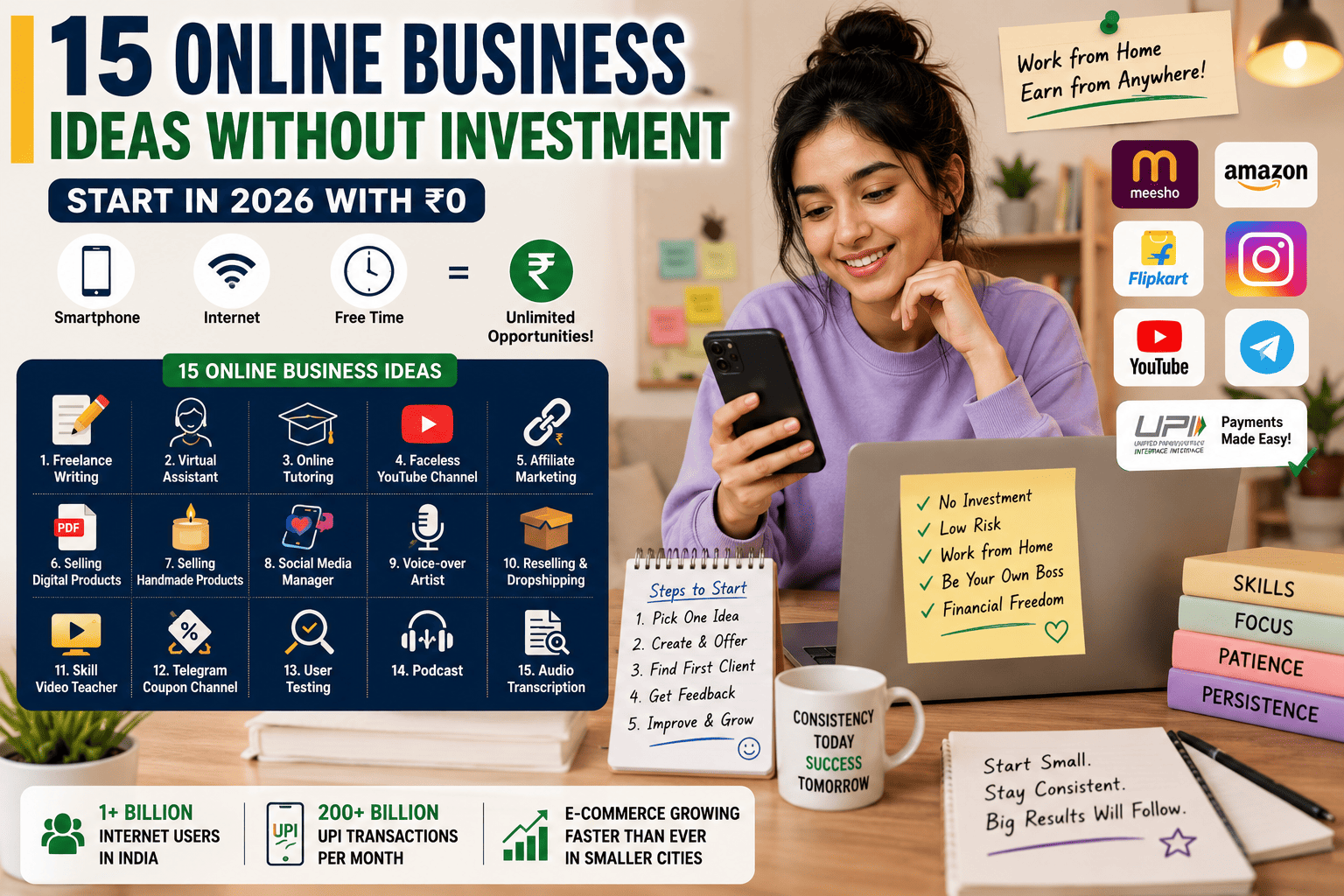
Many young Indians want to start an online business but don’t have money to invest. In 2026, you can still begin with zero rupees. A smartphone, internet connection, and some free time are enough.
There are plenty of online business ideas without investment that work even from small towns – freelancing, YouTube, selling on Meesho, affiliate marketing, and more. This post shares 15 of them for Indian readers, along with first steps, growth tips, and common mistakes to avoid.
An online business doesn’t need a rented shop, equipment, or inventory. A smartphone and internet connection give you access to customers across India and even the world – something a physical business cannot do.
No investment means you don’t worry about losing money. The cost of trying is zero. If one idea doesn’t work, switch to another.
Being online means you can use free platforms like Instagram, YouTube, Meesho, and Telegram to start selling products or services. You don’t need to build a website or have any technical skills.
India’s digital environment in 2026 makes all of this more achievable. There are over 1 billion internet users.
UPI processes over 200 billion transactions per month. The e‑commerce market continues to grow, and user growth in smaller cities is much faster than in big metros.
Free AI tools have also lowered the barriers for content creation and operations. Most young Indians have earned some money this way, one way or another, without putting in any funds.
Many Indian websites, startups, and small shop owners need blog posts, product descriptions, or social media captions, but they don’t have time to write them. You don’t need to be a literature expert – just write clearly and avoid major grammar mistakes.
How to start: Post your offer on LinkedIn, Telegram freelancing groups, or Indian platforms like Worknhire. To get your first client, write a free 300‑word sample. Save it as your portfolio. Then charge 200–500 ₹ per article and receive payment via UPI. Five articles a week can earn you 4,000–10,000 ₹ per month.
You can also earn income by starting your own blog. If you’re interested, read this article: [How to Start a Blog and Earn Your First ₹10,000 Per Month in India]
Small business owners, freelancers, and startup founders are overwhelmed with emails, customer queries, scheduling, and data entry. They are happy to pay 1,000–3,000 ₹ per month for help. You only need a smartphone or computer and basic knowledge of Google Calendar or spreadsheets.
How to start: Find a relative who runs an online shop or a friend who freelances, and offer to help for free for one week like reply to messages or organise tables. After a week, they will likely pay you to continue. Share screenshots of your work on WhatsApp status – other clients will find you. Managing 3–4 clients can bring 5,000–10,000 ₹ per month.
Indian parents want good tutoring in maths, English, or science, especially in smaller towns. You only need to be slightly better than secondary‑school level in a subject. Use free AI teaching tools like TheTeacherApp to prepare lessons.
How to start: Post a simple message in local WhatsApp groups or Facebook Marketplace: “Online tuition for X subject – first lesson free, then 100–200 ₹ per class on Google Meet.” Parents pay via UPI after the trial. Two classes a day can earn 6,000–12,000 ₹ per month.
Many people want to create YouTube videos but don’t want to show their face or don’t know how to film. Make a “faceless” channel about history facts, tech tips, motivational quotes, Indian mythology, or basic stock investing. Audiences only care about the information, not the host.
How to start: Create a YouTube channel and design a simple cover and thumbnails with Canva (free). Use ChatGPT to write a 1‑2 minute script. Generate a Hindi or English voiceover with free AI tools like TTSMaker. Find free video clips on Pexels or Pixabay. Edit everything together using CapCut (free) on your phone. Post at least 2 videos per week. After 3‑6 months, when you reach 1,000 subscribers and 4,000 watch hours, YouTube will place ads and pay you. A small channel can earn 2,000–10,000 ₹ per month depending on views.
You don’t make or store products. Just help Amazon, Flipkart, or Meesho sell items. When someone buys through your unique link, you earn a commission (usually 3–10%).
How to start: Register for free on Amazon Associates or Flipkart Affiliate. You will get your own short referral link. Find a heavily discounted product (mobile, household item, book) and copy your link. Post it on WhatsApp status, Instagram, or Telegram with a short caption like “Today’s deal: ₹1999 → ₹999. Click my link to grab it.” When someone buys, the commission is credited to your affiliate account and you can withdraw it to your bank account. Sharing 5–10 links a day can bring 3,000–15,000 ₹ per month.
Digital products include PDF guides, resume templates, budget sheets, meditation audio, or mobile wallpaper packs. You create them once and sell them many times – no inventory, no shipping.
How to start: Use Canva (free) to make a 10‑page PDF, for example “10 tips to improve English quickly” or “Weekly healthy meal plan.” Screenshot the first page and post it on Instagram or Telegram with text: “Just ₹99, pay and get the file instantly.” Put your UPI QR code directly on the image. After payment, send the file via Telegram or WhatsApp. Three to five sales a day bring 9,000–15,000 ₹ per month.
If you make candles, handmade soap, embroidery, jewellery, pottery, or any craft, you can work from home. No shop, no inventory.
How to start: Open a free Instagram account and post 5‑10 clear, well‑lit photos of your work. For example, write under each post: “Handmade, custom colours/sizes available. DM to order. I make after receiving full payment, dispatch in 3 days.” Clients contact you via DM. Once they pay by UPI, make the item. Ship it via India Post Speed Post or local delivery services like Dunzo or Shadowfax. A small parcel costs only ₹30‑50 to send. A handmade item priced ₹500‑2,000 can earn ₹300‑1,500 profit per piece.
The tea stall, tailor shop, mobile repair shop, or grocery store near you probably has no Instagram account, or has one but never updates it. They don’t realise that one post a day can bring young customers.
How to start: Pick a shop you visit often where the owner is friendly. Prepare 5 post ideas (product photos with a short line). Go to the owner and say: “I will manage your Instagram for one week for free. I will post one photo each day. If you see results, pay me ₹500 per month.” Take photos with your phone, add a few words and emojis using Canva, and post once a day. After a week, if customers start asking about prices or location, the owner will likely agree to pay you. Managing 5 such shops can earn ₹2,500+ per month, with less than one hour of work each day.
Many YouTubers, advertisers, online course creators, and audiobook platforms need voice‑over in Hindi, English, Tamil, or Telugu. They either cannot record themselves or have an unpleasant voice. You just need a smartphone and a quiet room.
How to start: Record a 30‑second sample using your phone’s voice recorder. Say something like “Hello, this is your daily dose of Indian news. Today we talk about…” Upload this sample to Fiverr, Freelancer, or Telegram freelancing groups. Also search YouTube for “voice‑over needed” and contact small creators directly. When a client sends a script (200‑500 words), read it in a quiet place. You may need two or three takes. Send the final audio via Telegram. Charge ₹50‑100 per minute. A 5‑minute voice‑over earns ₹250‑500. Five orders a week gives 5,000‑10,000 ₹ per month.
Both methods let you sell without holding stock. The difference: reselling (e.g., on Meesho) means you collect the customer’s money, then place the order on Meesho with the customer’s address, and Meesho ships it – you earn the difference. Dropshipping means you find a supplier, collect payment from the customer, transfer the wholesale price and address to the supplier, and the supplier ships directly. Both are zero‑investment.
How to start: Register for free on Meesho as a reseller. Share product images to your WhatsApp contacts. When a friend wants to buy, they pay you via UPI; you then order on Meesho using their address. At the same time, search Telegram for “India dropshipping” groups to find suppliers. Post their product photos on Instagram or Telegram. When a customer pays you, send the wholesale amount and address to the supplier. You can use both methods – whichever sells better. A T‑shirt can earn ₹50‑100 through reselling and ₹100‑200 through dropshipping. Five sales a day easily brings 10,000‑20,000 ₹ per month.
You can cook, draw, play guitar, use Excel, edit photos, or write a good CV. Many people want to learn and will pay a little money. You don’t need editing skills or expensive equipment.
How to start: Pick a specific skill, for example “15‑minute Indian fried rice.” Place your phone on a stand, film the whole process, and explain each step. Do not edit – just film once. Save the video. Create a paid Telegram group (₹200‑500 entry fee). Share the group QR code on Instagram and WhatsApp. After payment, approve the learner and post the video inside the group with simple text instructions. Alternatively, upload to YouTube to earn ad revenue, but a paid group makes money faster. When 100 people join at ₹300 each, you earn ₹30,000 – from just one video.
Most people want to save money when shopping, and millions search online for discount codes every day. Collect daily offers from different platforms and post them in one place.
How to start: Open Telegram and tap “New Channel.” Choose a catchy name like “Flipkart Daily Deal” or “India Discount Alerts.” Spend 15‑30 minutes every day browsing Amazon, Flipkart, Myntra, Zomato, Swiggy, BigBasket. Go to their “today’s deal” or “coupons” section, copy the coupon code and product link. Paste them in your channel with a short note: “[Product name] was ₹999, now ₹699 with code SAVE30.” Invite your friends and family, and ask them to invite their friends. When your channel reaches 500 members, new brands will approach you and pay you to post their offers. One promotional post can earn ₹500‑2,000, depending on member count. At 2,000 members, 4‑5 paid posts per month bring 4,000‑10,000 ₹.
Before launching a new website or app, companies need real people to try it and find what is confusing or broken. They pay for recorded screen sessions plus your spoken thoughts. You don’t need technical skills – just talk.
How to start: Register for free on UserTesting or Trymata. Fill in your profile: you speak Hindi and English, your phone model, your internet speed. When a suitable test is available (usually 1‑3 tasks per day), you get an email or app notification. Open the task; you will be asked to open a website or app. As you use it, speak out loud: “This green button is too small – I almost missed it” or “I clicked here and it took 5 seconds to load.” The session is screen‑recorded and lasts 10‑20 minutes. After completion, the platform pays you $5‑10 (about ₹400‑800) via PayPal. PayPal charges a small withdrawal fee. Three tests a week earn 5,000‑10,000 ₹ per month.
Podcasts need only audio – no video, no face. In 2026, more Indians listen to podcasts while commuting or doing housework.
How to start: Download Anchor (now Spotify for Podcasters). It is completely free and includes recording and distribution. Open the app, tap “Record,” and speak for 15‑20 minutes. Talk about any topic you enjoy: this week’s cricket match review, recent Hindi movies, how to save money in a small town, or startup lessons. You don’t need to be perfect – just speak naturally. The app automatically distributes your show to Spotify, Apple Podcasts, Google Podcasts, and all major platforms. Share your show link on WhatsApp and Telegram. When you get more than 1,000 downloads per episode, Spotify places ads inside your show and shares the revenue. Typically, 1,000 downloads earn ₹200‑500. You can also read sponsor ads yourself and charge directly.
Many bloggers, journalists, researchers, lawyers, and companies need interview recordings, meeting notes, or lecture audio converted into text. They don’t have the time to do it themselves. You only need a pair of earphones and typing ability.
How to start: Post on Telegram freelancing groups or LinkedIn that you offer Hindi or English transcription. To get your first client, transcribe a 5‑minute sample for free. Once you have a sample, charge ₹5‑10 per minute of audio. For example, a 30‑minute interview would cost ₹150‑300. When you receive an audio file, play it on your phone or computer and type into Notepad or Google Docs. You can rewind as many times as needed. With practice, one hour of audio takes about 2‑3 hours to transcribe. Transcribing one 30‑minute audio per day gives you 4,500‑9,000 ₹ per month. Demand is steady, especially from online course creators and YouTubers.
One of the 15 ideas above should fit you. But knowing the ideas is not enough. The next real question is: after picking one, how do you actually begin?
You can follow the steps below or adjust them to your own situation.
1. Know yourself and make a sample.
Think about what you enjoy and are good at. Look at what others are doing. Pick one direction you can stick with for three months. Then make one simple sample – a free article, a voice clip, a product photo, or a few coupons.
2. Set up a simple page and find your first customer.
For services, use LinkedIn or Telegram. For products or content, open a free account on Instagram, YouTube, or Telegram. Write clearly what you offer. Then find your first customer from family or friends. Offer the first job for free or half price in exchange for a review screenshot.
3. Work one hour every day.
Do the same task at a fixed time each day. You may see no income for the first two weeks, but by the end of month one you should earn your first money.
4. Get feedback and improve.
After each job, ask what could be better. Fix it, save good reviews, raise your price a little, and find the next customer
You don’t need to be perfect. Your first try may earn only 50 rupees. That’s fine. You lose no money because you invested nothing. Keep trying, adjust, and don’t stop. Three months later you will see progress.
Don’t put money into it.
All the ideas above require zero rupees to start. Use free platforms, free tools, your own phone, and your time. If someone tells you “pay 500 rupees for this course first” or “you need to buy a starter kit,” don’t believe them.
Don’t quit your job or drop out of school too soon.
Many people want to go full‑time after just a few days, but the first few months may only bring a few hundred rupees – or even just几十. Start with your free time – after work or on weekends. Only consider going full‑time after you have earned a steady income above your current salary or living expenses for three consecutive months.
Don’t believe “get rich in three days” claims.
On Telegram or YouTube, you often see ads that say “zero cost, earn tens of thousands in three days.” These are scams. Real online business – the first month, earning 500 rupees is already good. Income grows slowly, one hour a day at a time. Anyone who promises quick money is likely a scammer.
Now you see that in India, starting an online business without investment is easier than ever. Anyone with some free time, a smartphone, and a few free tools can earn from home.
What really matters is not money, but consistency, learning the right methods, and choosing a monetization approach that fits your strengths. Your first article may not be great. Your first video may get zero views. Your first order may earn only 50 rupees. That’s fine. Work one hour every day, improve as you go, and three months later you will see the difference.
If you want to start with something simple and repeatable, Taurus is a good option – zero cost, earn through tasks and withdraw via UPI.
Beginners can start earning online through freelancing, tutoring, affiliate marketing, content creation, coaching, and referrals.
ChatGPT can be a powerful tool for making money through a range of content writing and editing services. Fiverr’s data shows that freelancers and independent workers tend to use AI to generate new ideas and write content. You can use it to draft blog posts, articles, or website content as well as edit.
Making money online as a beginner is highly achievable if you leverage your current skills and utilize digital platforms. The fastest routes require minimal investment, while building long-term sustainable income involves selling digital services, content creation, or running an automated e-commerce store.
The 7-3-2 rule elaborates that how rapidly your money can grow over time. Compounding works when the returns generated by an investment begin to earn returns themselves. Over time, this creates an exponential growth curve rather than a linear increase.
Earning $100/day online ($3,000/month) is achievable through five high-value skills: niche coaching, curriculum design, community management, content creation, and no-code app building.
Written by Abhinav Sharma
Abhinav Sharma is an internet passive income expert from India. He specializes in building automated profit systems, focusing on transforming digital products, smart affiliate marketing, and content assets into consistent “passive income.” His proven strategies have successfully guided thousands of students worldwide to break free from the cycle of trading time for money, achieving both financial and geographic freedom.
Taurus App Daily Financial Outlook: Earn Money at Home (2026 Guide)
The Taurus App is a mobile-first task and cashback aggregation platform designed for individuals seeking light, time-efficient side earnings directly from their smartphones.
 Manpreet Singh
Play Game and Earn Paytm Money: The 2026 Guide to Instant Payouts
Want to play game and earn Paytm money? Learn the top game categories, avoid scams, and use our quick-start guide to get your first instant payout.
Manpreet Singh
How to Play Free Online Games to Earn Money in India (2026 Manual)
Want to play free online games to earn money in India? Read our 2026 manual to find a real daily routine, trusted apps, and avoid fake games.
Manpreet SinghTable of contents:


Discover diverse earning methods on Taurus Cash APK, a mobile app offering tasks, skill-based games, and refer & earn programs. Join for a seamless income by completing daily tasks & earning commissions!




Businesse cooperation: [email protected]

 How to Earn