


English

 Manpreet Singh
Share: 


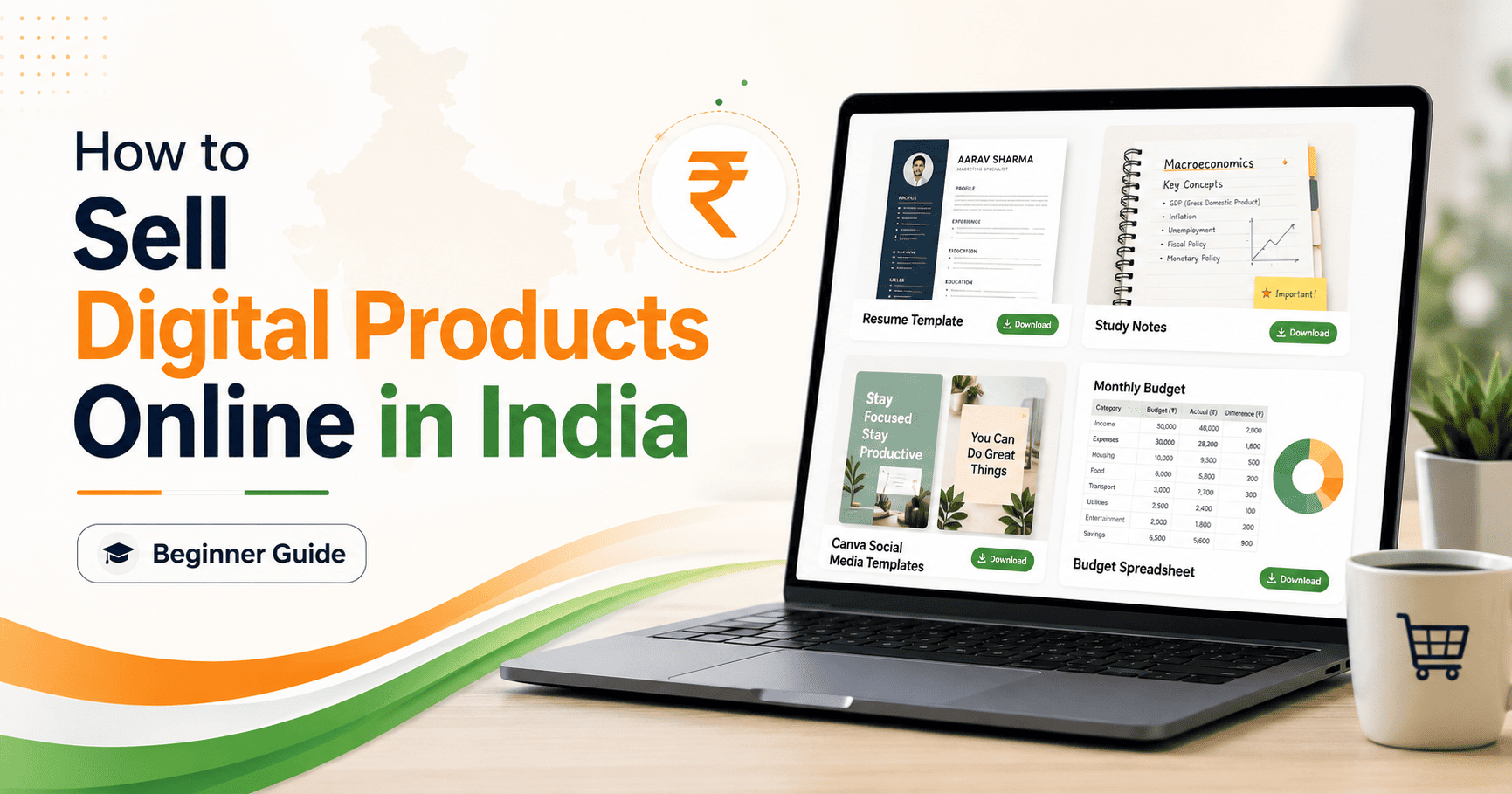
For many beginners, the hard part of starting an online business is not just finding an idea, but dealing with stock, delivery, packaging, and upfront costs. This is why learning how to sell digital products online in India can be a practical option. Digital products, such as templates, notes, planners, eBooks, or online guides, can be created once and delivered online whenever someone buys them.
But that does not mean every file will sell. You still need to choose a product people actually need, create it properly, list it on the right platform, price it well, and promote it. In this guide, you will learn the process step by step, including how to choose a product idea, create it, pick the right platform, price it, promote it, and avoid common beginner mistakes.
Digital products are items that are created, sold, and delivered online. Instead of shipping a physical item, you give buyers a file, template, access link, or online resource through email, a download page, or a selling platform.
Since there is no physical product to handle, you do not need stock, packaging, warehouse space, or courier delivery. Once the product is ready, the same file can be sold again and again without being recreated for every order. This is one reason digital products are attractive to beginners who want to test an online income idea with lower upfront costs.
In India, many digital products are connected to practical needs. Students may look for study notes or exam guides, freshers may need resume templates, and small business owners or creators may use Canva templates, invoice formats, content calendars, budget spreadsheets, digital planners, business forms, or short skill-based guides.
Students who are not ready to sell notes or templates yet can start with other online side hustles for students first.
Selling digital products online in India works better when you treat it like a small test, not a big launch. You do not need a full store, a large audience, or a perfect product at the beginning. What you need first is a clear buyer, a useful product idea, and a simple way for people to pay and receive the file.
Start with a niche where people already have a practical need. In India, the easiest digital products for beginners usually come from education, job search, small business marketing, personal finance, productivity, or skill learning. These areas work well because buyers are not paying for a file only. They are paying for something that helps them save time, prepare faster, look more professional, or complete a task more easily.
For example, a student preparing for exams may need revision notes, chapter summaries, practice sheets, or a study planner. A fresher applying for jobs may need a resume template, cover letter format, LinkedIn headline examples, or an interview checklist. A small business owner may need Instagram post templates, WhatsApp catalog designs, invoice formats, menu templates, or a simple expense tracker.
The more specific the product is, the easier it becomes to sell. “Canva templates” is too broad because it does not tell the buyer who it is for. “Instagram menu templates for small food businesses” is clearer. “Study notes” is also vague, while “Class 12 commerce revision notes” gives the buyer a direct reason to care. A general resume template may be easy to make, but a “fresher resume template for internship applications” feels more useful to a specific person.
Before moving ahead, ask whether the product has a clear audience, a clear use case, and a clear result. A good first product does not need to be big. It needs to be easy for the buyer to understand within a few seconds.
Once you have a product idea, check whether people are already looking for this type of help. This saves you from spending days creating something nobody wants.
Search the idea on Google, YouTube, Pinterest, Instagram, marketplaces, and relevant communities. Read comments, reviews, search suggestions, and questions from your target audience. The useful signs are often simple: people asking for a format, a ready-made template, a faster way to prepare, or an easier way to manage something.
Remember, you are not looking for something to copy. You are looking for repeated problems that can be solved with a simple digital product.
You can also test the idea with a small free sample. Share one planner page, one template preview, one checklist, or one short guide. When people save it, ask for the full version, message you, or comment with questions, the idea has a stronger signal.
Now build the smallest version that still solves the problem. This is not a rough draft, but it also does not need to be a huge bundle.
A first product could be a fresher resume template with editing notes, a short exam planner, a small Canva template pack, a Google Sheets budget tracker, or a PDF guide that solves one specific problem. Use Canva for templates and designs, Google Docs or Word for guides and notes, Excel or Google Sheets for trackers, and Notion for dashboards or productivity systems.
The test is simple: when the buyer opens the product, can they understand how to use it without needing a long explanation? If yes, the first version is ready to sell.
The product should feel complete before anyone buys it. That means clear file names, a short instruction page, preview images, format details, and a simple explanation of what is included.
For a fresher resume template, do not upload only the editable file. Add a preview image, a short editing guide, and notes on what to write in each section. For study notes, mention the class, subject, chapters covered, and file format. For Canva templates, explain whether a free Canva account is enough.
This small preparation makes the product easier to trust and reduces confusion after payment.
Choose one selling setup based on how buyers will discover your product. New sellers often make this harder than necessary by trying to use every platform at once. In the beginning, one clean path is enough.
A simple product page with a payment link can work well when your buyers come from Instagram, WhatsApp, Telegram, YouTube, or a small community. This setup is useful for products you can explain directly, such as resume templates, study planners, or Canva packs. You talk about the problem in your content, send people to one page, and let them buy from there.
A digital product platform is better when you want automatic delivery. The buyer pays, receives the file, and you do not need to manually send every order. This is useful once you expect repeat sales or when you do not want to manage payments through direct messages.
Marketplaces can work for templates, printables, design assets, and learning resources because buyers may already search there. The trade-off is competition. Your product page, preview images, title, and description need to be stronger because people will compare you with many similar se
A blog or website takes more time, but it is better for long-term selling. This works especially well when your product can be supported by SEO content. For example, an article about fresher resume mistakes can lead nat
For Indian buyers, payment comfort also matters. INR pricing, UPI-friendly checkout, clear delivery instructions, and a trustwo
Start with the easiest setup that lets buyers pay smoothly and receive the product without confusion. You can move to a website, marketplace, or multiple channels later once the product proves demand.
Pricing is difficult for beginners because there is no fixed rule. The practical way is to price based on the depth of the product and the risk for the buyer.
A single template, short guide, checklist, or spreadsheet should usually be treated as an entry product. It should feel easy to try. A product with examples, instructions, editable files, or multiple formats can be priced higher because it gives more help. A bundle can cost more when it solves a bigger part of the buyer’s problem.
For example, one fresher resume template should not be priced the same as a full job application kit. The kit may include resume templates, cover letter samples, LinkedIn headline examples, interview questions, and a checklist. That gives the buyer more value, so the price can be higher.
The same logic works for study products. A single revision planner is a small product. A full exam preparation pack with notes, practice sheets, a study timetable, and a revision checklist can be priced as a bundle.
Before setting your price, check similar products and compare what they include. Do not copy the price blindly. A polished product with examples and instructions can charge more than a simple file. A product made for students may need a lower entry price than one made for business owners. Also account for platform fees, payment charges, discounts, and possible refunds, because the listed price is not the same as your final profit.
For the first version, choose a price that is easy enough for buyers to test but not so low that the product looks careless. Once you get feedback, improve the product, add examples, create a bundle, and raise the price naturally.
Once the product is live, do not wait for random traffic. Put it in front of people who already have the problem.
A resume template can be promoted through content about fresher resume mistakes, internship applications, LinkedIn profile tips, and interview preparation. Study notes can be promoted through revision tips, chapter explanations, and exam planning content. Canva templates can be promoted by showing small businesses how to create menus, product posts, offers, and festival announcements faster.
The product should feel like the next useful step, not a forced sales pitch. A free sample helps with this. Give away one page, one section, one checklist, or one template preview. People who find the sample useful are more likely to trust the paid version.
At this stage, ten interested buyers are more useful than a thousand random views. Your goal is to prove that people understand the product and are willing to pay for it.
The first version is mainly for testing. Once people start buying or asking questions, pay attention to where they get confused and what they ask for next. This feedback is often more useful than guessing another product idea from scratch.
For example, buyers of a resume template may ask for a cover letter format or LinkedIn profile tips. Students who download a study planner may also want subject notes or practice sheets. Someone using a budget tracker may later need a savings planner. A small business owner who buys Canva templates may ask for festival posts, menu designs, or a monthly content calendar.
Use these signals to improve the current product first. Add clearer instructions, extra examples, another file format, or a short tutorial if needed. Then create the next product around the same buyer instead of jumping into a completely different niche.
This is how digital products grow in a practical way. You start with one focused offer, test it with real buyers, improve it based on feedback, and then build related products that solve the next problem for the same audience.
Once your product is live and you start getting your first buyers, the next question is usually about income. The truth is that earnings from digital products are not fixed. They depend on the product type, price, traffic source, buyer demand, and the fees charged by your selling platform or payment provider.
A simple product may bring small sales at first. For example, a fresher resume template priced at ₹199 will make ₹3,980 from 20 sales before fees. A study notes bundle priced at ₹499 will make ₹14,970 from 30 sales before fees. A more complete offer, such as a mini course or job application kit priced at ₹999, will make ₹9,990 from 10 sales before fees.
But these numbers are only gross revenue, not final profit. You still need to subtract payment charges, platform fees, discounts, refunds, and any tools you use to create or deliver the product. That is why beginners should not judge success only by the first month’s income.
In the beginning, the more important goal is proof. If a few people are willing to pay for your product, it means the idea has potential. From there, you can improve the product, raise the price, create bundles, add related products, and bring more traffic through content, social media, marketplace search, or your own website.
So instead of expecting passive income immediately, treat the first product as a test. A single digital product may start small, but once you understand what buyers want and build more useful offers around the same audience, the income can become more stable over time.
Once you’ve made the first few sales and validated that people are willing to pay, the next step is to sell more without starting from scratch. Small changes to how you present and position your product make a much bigger difference than building ten different things. Here’s what actually works.
Name it for a specific person.
“Fresher Resume Pack for IT Jobs” works better than “Resume Template” because it tells the buyer exactly who this is for (freshers looking for IT roles) and what’s inside (a pack, not just one file). A vague name makes people scroll past. A specific name makes them think “this is for me.”
Show, don’t just tell.
Adding a screenshot or mockup works better than describing it because Indian buyers want to see the actual file before paying. A Canva template on a mockup looks real. A budget sheet with visible formulas builds trust. Words can be faked. A preview can’t.
Give a small free sample.
Offering one full chapter, a watermarked template, or the first two pages of a planner lowers hesitation without giving everything away. Buyers need proof that your file isn’t low quality. A sample gives them that proof, so they feel safe paying for the rest.
Keep the same audience.
If one product doesn’t sell, don’t jump to a recipe ebook or a yoga planner. Instead, make a second product for the same people — for example, after a resume template, make a cover letter kit or LinkedIn headline generator. Your audience is your real asset, not a single product.
Even when you’re doing most things right, small mistakes can quietly kill your sales.
Take giving away too much for free. Some new creators think offering the complete product as a sample will attract buyers. But once someone has the full file, they have no reason to pay. Keep your free sample small — one chapter, not the whole book.
The same goes for pricing. Most buyers want to know how much something costs before they decide. If you hide the price behind three clicks or force them to enter an email just to see it, they’ll leave. Put the price clearly on your product page, right next to the preview.
Delivery instructions are another thing that gets overlooked. You assume buyers will figure out how to open and use your file. They won’t. If you’re selling a Canva template, tell them they need a free Canva account. If it’s a spreadsheet, mention that Excel or Google Sheets is required. Confused buyers often end up asking for a refund.
And then there’s the mindset of expecting one product to do all the work. Starting with a single template or guide is fine — everyone begins there. But don’t stop. As soon as you see even one or two people willing to pay, start thinking about what else the same audience might need. The first product proves your idea. The next ones turn it into something sustainable.
Instead of guessing what might sell, look at what Indian buyers already pay for. Beyond the categories mentioned earlier, here are a few more worth considering.
AI art and design assets
Downloadable AI-generated art, illustrations, wallpapers, and festival greeting cards. Young Indian users are increasingly comfortable with AI tools, and decorative or digital art has a real market.
Marketing templates for small businesses
India has a large number of small shop owners who need festival posters, promotional images, and price lists but cannot afford a designer. A Canva marketing pack covering major festivals throughout the year works better than a single generic template.
Teaching resources for educators
Indian teachers are willing to pay for materials that save preparation time. Ready-made classroom activity sets, practice worksheets, editable exam paper templates, and interactive presentations all sell.
Podcast and audio products
The Indian podcast market is expected to grow significantly by 2033. Intro and outro audio clips, podcast cover templates, episode planning sheets, and guest intake guides can be sold to those who want to start a podcast but do not know where to begin.
Digital products sell in India for a simple reason: someone already has a problem, and your file can help. You don’t need to start big. A ₹199 set of notes or a single template is enough. One sale tells you the path works.
If creating a product feels too early, start with these beginner ways to earn money online first.
Take a small problem you’ve already solved for yourself, turn it into a file, and put it online. You don’t need to be ready. You just need to start.
No. Many sellers start with platforms like Gumroad, Sellfy, or even just Instagram and WhatsApp with a payment link. A website helps later for branding and SEO, but it is not required for the first sale.
Gumroad and similar platforms accept UPI, cards, and international payments. They also send the file automatically after purchase. If you use WhatsApp or Instagram, you can collect payment via UPI and send the file manually. For the first few sales, manual delivery is fine.
It can happen, but it is less common with smaller-priced products (₹199–₹499). Most buyers just want the file for their own use. Watermarking samples and limiting sharing links reduces the risk. Going after resellers is usually not worth the time.
You do not need to be an expert. You just need to be one step ahead of the person who is struggling. A college student who just passed an exam can sell revision notes to juniors. Someone who figured out Canva can sell templates to small business owners who have not.
Written by Manpreet Singh
An Internet wealth architect from India, a true master of turning clicks into gold. He possesses the innate ability to transform complex online models into actionable blueprints for everyday people, specializing in internet monetization, affiliate marketing, and mobile app revenue streams. Through his “low barrier to entry, high compounding returns” practical strategies, he has successfully guided thousands of global followers to convert their skills and passions into substantial online income.
Taurus App Paid Surveys Guide: Zero Investment Daily UPI Cash
Among the multiple micro-task options available on the Taurus App, the Questionnaire section offers a direct, zero-investment path for Indian users looking to generate daily side income.
Manpreet Singh
Watch Video and Earn Money App India: Daily Yields, Rules & Fast UPI Transfers (2026)
For smartphone users searching for a reliable earn money app and video platform in India, task aggregators like Taurus have changed how micro-earnings work.
Manpreet Singh
Earn Real Cash on Teen Patti Master via Taurus App
If you are looking for a reliable way to win real money playing mobile games, Teen Patti Master is currently one of the most popular skill-based card games in India.
Manpreet SinghTable of contents:


Discover diverse earning methods on Taurus Cash APK, a mobile app offering tasks, skill-based games, and refer & earn programs. Join for a seamless income by completing daily tasks & earning commissions!




Businesse cooperation: [email protected]

 How to Earn