


English

 Abhinav Sharma
Share: 


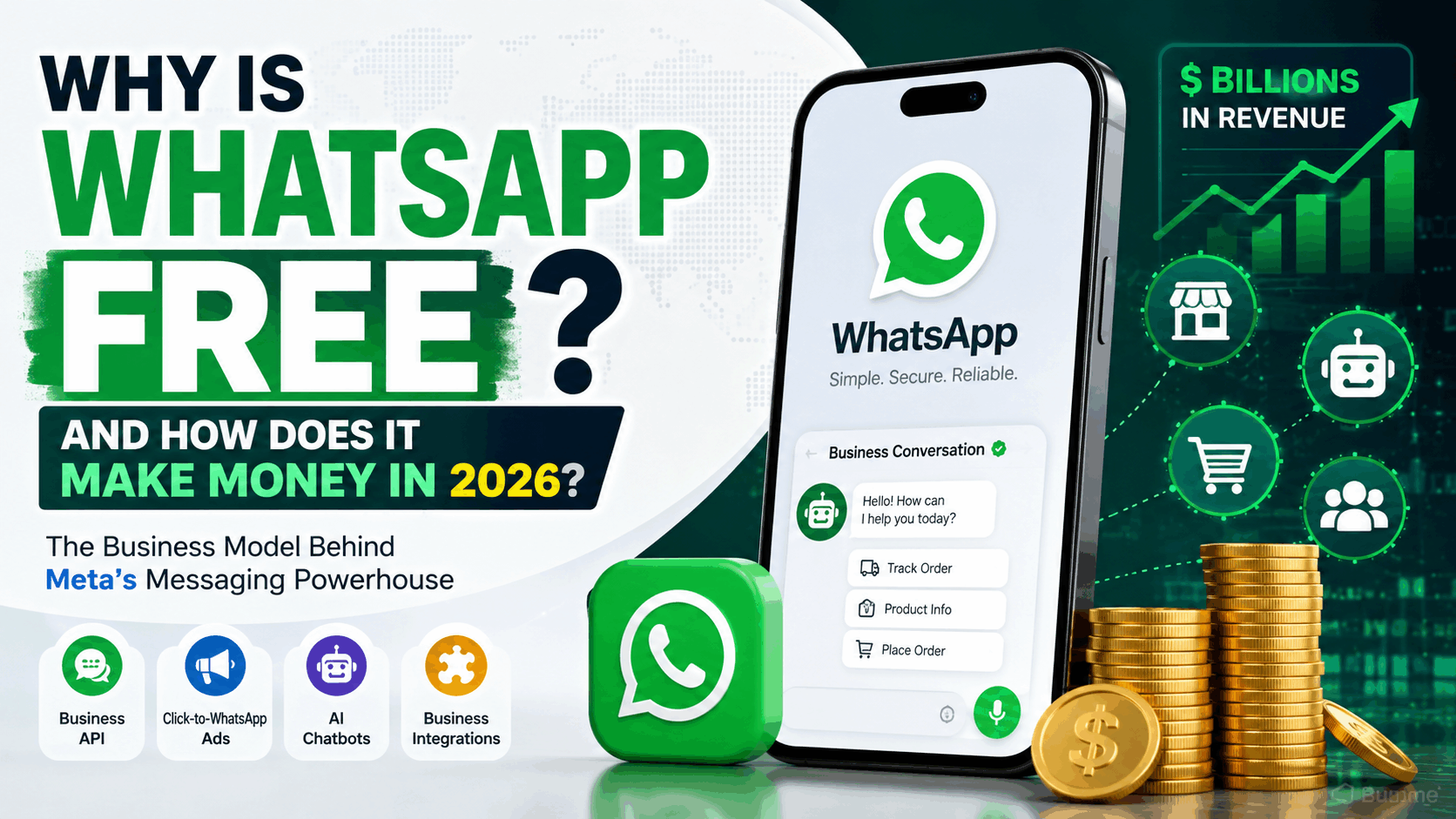
In 2026, WhatsApp handles over 100 billion messages every day. More than 1 billion are business messages. Not a single one costs the sender extra. So where does the money come from?
This question matters. Meta owns WhatsApp. Meta makes most of its money from advertising. But WhatsApp has no ads. No subscription fees. For years, analysts wondered how Mark Zuckerberg would monetize this platform. The answer is more complex than most people think.
Jan Koum and Brian Acton built WhatsApp with one principle: no ads. Their early revenue model was an annual subscription fee. That ended when Facebook acquired the platform in 2014. Meta paid 19 billion dollars and immediately made WhatsApp free for everyone.
The economics changed overnight. A paid app limits its user base. A free app with 2 billion users opens entirely different possibilities.
Meta keeps WhatsApp free because free access means faster growth. Faster growth means more data. More data means better AI training. Better AI makes the platform more useful for businesses. More businesses pay for access.
The cycle feeds itself.
WhatsApp was built to feel like a utility. That feeling is intentional. When users don’t feel sold to, they stay longer. They share more. They become the audience businesses want to reach.
Meta earns from businesses, not users. Here is how it works.
WhatsApp Business API
Companies pay to send messages through the Business API. Pricing varies by country. In India, businesses pay around ₹4–9 per business message. User replies cost much less, sometimes nothing.
Meta’s Q4 2025 earnings report shows Business API revenue grew 47% year-over-year. India and Brazil account for over half of all business messages sent globally.
Why do businesses pay? Because it works. WhatsApp messages have open rates above 90%. Email averages 20-30%. When a customer receives an order update on WhatsApp, they actually read it. That reliability justifies the cost.
For Indian users, one important constraint applies: a five-year regulatory ban restricts WhatsApp from sharing user data with Meta for advertising purposes. This limits certain aspects of Meta’s cross-platform data strategy within India.
Click-to-WhatsApp Ads
Meta places “Message Us” buttons inside Facebook and Instagram ads. When you click, you enter a direct chat with the business. Meta earns from the ad. The business earns from the sale.
This creates a simple path: ad → chat → sale. Traditional display ads interrupt browsing. WhatsApp ads meet customers where they already communicate. Businesses that use click-to-WhatsApp ads report higher acquisition costs but lower churn rates.
AI Customer Service
Beyond traditional ads and messaging fees, AI tools have opened a new revenue stream. As of May 2026, WhatsApp has begun rolling out Business AI in India — an AI agent available in all local languages to help small businesses automate customer response, capture leads, and handle bookings. The feature is currently being deployed gradually to eligible WhatsApp Business users in India.
Businesses are adopting AI chatbots on WhatsApp to handle queries automatically. These bots answer questions, process orders, and guide purchases without human staff. The AI works 24/7. It can serve thousands of customers at once.
Small restaurants use it for reservations. E-commerce brands use it for shipment tracking. Medical clinics use it for appointment reminders. The automation cuts costs sharply. One AI agent can replace what a team of 10 customer service reps used to do.
As businesses adopt AI tools, they depend more on WhatsApp. Switching becomes expensive. Lock-in increases. This creates long-term revenue stability. One caveat: payment functionality within Business AI is still marked as “coming soon” and has not launched as of May 2026.
The AI story goes deeper than chatbots. Meta AI now lives inside WhatsApp. You can ask questions, generate images, or get writing help without leaving the app. This changes the platform’s purpose entirely.
Before, WhatsApp was a communication tool. Now it doubles as a discovery platform. Users find products, services, and information through AI chats. Businesses can advertise inside those conversations. Meta earns from AI-mediated commerce.
As AI improves, businesses must invest more to stay competitive. Small shops that ignored AI tools three years ago now struggle to match AI-enabled competitors. The democratization of AI creates pressure, not just opportunities.
Could AI become WhatsApp’s biggest revenue driver? The signs point that way. Meta is developing premium AI features for enterprise customers. Advanced analytics, predictive tools, and custom AI assistants may become paid add-ons. AI services may eventually rival traditional Business API revenue.
If business message volumes drop — due to price increases or AI fatigue — Meta has backup revenue from AI tools. This diversification provides stability. But it also raises questions about user experience if AI features become too intrusive.
The acquisition makes more sense now that we understand how WhatsApp earns money. Facebook paid 19 billion dollars for WhatsApp in 2014. Critics called it overpriced. The reasoning: messaging apps are infrastructure. Infrastructure means leverage. Leverage means pricing power.
That logic proved right. WhatsApp became the communication layer billions use daily. Businesses cannot ignore it. Marketing campaigns target WhatsApp users. Sales happen inside chat windows. This position gives Meta advantages pure social apps don’t have.
Data flows between WhatsApp and Meta’s other products. However, for Indian users, this integration faces significant restrictions due to an ongoing regulatory ban.
For Indian users, WhatsApp’s privacy and data practices are shaped by active legal action from the Competition Commission of India. In November 2024, the CCI imposed a ₹213 crore penalty on WhatsApp for data-sharing practices and issued a five-year ban on sharing user data with Meta for advertising purposes. WhatsApp initially challenged the order but withdrew its appeal in February 2026 after the Supreme Court criticized its practices. The company has since committed to complying with the CCI’s directives.
What this means for Indian users: Meta cannot freely use WhatsApp data to target ads on Facebook or Instagram within India for the duration of the ban, which runs through 2029 or potentially 2031. The platform is also under judicial scrutiny over scam prevention. WhatsApp has agreed to SIM binding measures and more robust fraud detection systems following Supreme Court scrutiny over digital arrest scams. These legal constraints make WhatsApp’s monetization story in India more complex than in other markets. The outcome remains unresolved, with the Supreme Court yet to deliver a final verdict.
So far we have covered how Meta earns from businesses. But what about individual users? Yes. Several legitimate ways exist.
WhatsApp Business offers free tools for entrepreneurs. You can show catalogs, automate greetings, and manage customer queries. Larger businesses pay for API access. This enables deeper integration with CRM systems, Shopify stores, and other tools.
Selling products through WhatsApp has grown popular in India. Sellers use WhatsApp to negotiate and showcase products, then complete payments through PhonePe or Google Pay — India’s dominant UPI apps. WhatsApp is the storefront; other apps handle the checkout.
WhatsApp Pay exists, but PhonePe and Google Pay dominate India’s UPI market. In early 2026, WhatsApp Pay processed around 130 million transactions monthly, while PhonePe handled over 10.5 billion. The gap remains enormous.
Every model has vulnerabilities. What if businesses find that AI chatbot conversion rates don’t beat email marketing? What if Meta raises Business API prices too aggressively? Commercial message volumes could drop.
Then what? Would Meta start charging regular users? Would they relax privacy rules for more targeted ads? No one knows yet.
In India specifically, the regulatory outcome will shape how much Meta can actually monetize WhatsApp. The five-year data-sharing ban directly affects the cross-platform advertising synergy that works in other markets. If the Supreme Court rules against WhatsApp in the pending case, the restrictions may tighten further.
These questions determine WhatsApp’s future. The platform has grown from a free messaging app into commercial infrastructure powering millions of businesses. That transformation is impressive, but not complete. The next chapter — driven by AI and enterprise services — is still being written. In India, regulators will play a major role in how that chapter unfolds.
In India, businesses typically pay around ₹4–9 per business message. In Brazil, pricing follows a similar range. User replies cost much less. Enterprise customers with high volumes negotiate custom rates. Cost per message usually drops as volume increases.
Meta AI uses behavioral signals — usage patterns, engagement metrics, conversation topics — to improve its models. Message content itself is not used for training. In India, a five-year regulatory ban further restricts how Meta can use WhatsApp data. Some users still feel uncomfortable with behavioral data collection. The distinction matters, but the discomfort is real.
Partially. You can disable some AI features through settings. Complete removal is not possible. Meta AI is integrated into the platform’s core. If you want to avoid AI entirely, WhatsApp may not suit you in 2026. This reflects Meta’s commitment to AI as a platform feature.
Written by Abhinav Sharma
Abhinav Sharma is an internet passive income expert from India. He specializes in building automated profit systems, focusing on transforming digital products, smart affiliate marketing, and content assets into consistent “passive income.” His proven strategies have successfully guided thousands of students worldwide to break free from the cycle of trading time for money, achieving both financial and geographic freedom.
Share and Earn Money App in India: A Complete Guide to Real Platforms
Want to earn real cash by sharing links? This guide shows how genuine share and earn money apps work, how to spot fakes, and start earning safely today.
Abhinav Sharma
Legit Part Time Apps for Students in India from Home (2026 Guide)
Best legit part time apps for students in India from home. Compare earnings, read honest reviews, and learn how to avoid fake platforms. Your starting point.
Abhinav Sharma
Which Walking App Pays More in India? (2026 Comparison)
Which earn money by walking app in India actually pays? Compare 5 best apps, real payouts, steps, and withdrawal methods. Get honest answers.
Abhinav SharmaTable of contents:


Discover diverse earning methods on Taurus Cash APK, a mobile app offering tasks, skill-based games, and refer & earn programs. Join for a seamless income by completing daily tasks & earning commissions!



Businesse cooperation: info@taurusofficial.in

 How to Earn